A History of Modern South Asia by Ian Talbot
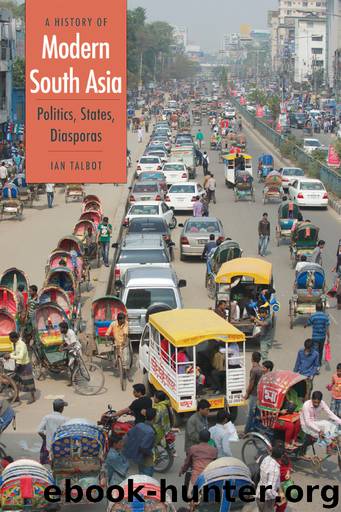
Author:Ian Talbot [Talbot, Ian]
Language: eng
Format: epub
Publisher: Yale University Press
Published: 2015-03-05T16:00:00+00:00
PART V
ELEVEN
Challenges to Nehruvian India
The period from 1964 until 1991 brought significant changes in economic policy and political practice from the foundational Nehruvian era. These changes pointed the way to further and even more profound transformations in India’s political, social, and economic landscape in the twentieth century’s closing decade. The break with Nehru’s vision has not, however, been merely a straightforward repudiation by a resurgent Hindu right that had always opposed it. Congress oversaw many of the transformations, from economic reform to the shift away from nonalignment or secularism. Indira Gandhi posed the greatest challenge to the parliamentary democracy espoused by her father. Before turning to this, we will examine the brief Shastri premiership, which followed Nehru’s death.1 Although it was tragically short-lived (9 June 1964–11 January 1966), it marked the first tentative steps away from the path laid out since independence.
Lal Bahadur Shastri was part of the Congress old guard who had made considerable personal sacrifices during the nationalist movement. He had spent nine years in jail. Short in stature and unassuming, he was nicknamed the Sparrow. He had loyally served as railways minister (1951–56) and home minister (1961–63). His hard work earned him Nehru’s favor, but had come at the expense of a heart attack in October 1959.2 When Nehru died, this modest son of UP, who had never traveled outside of South Asia, became the unanimous choice for prime minister of the “Syndicate”—regional Congress bosses headed by K. Kamaraj, chief minister of Madras. Just as later with Indira Gandhi, the Syndicate saw the elevation of an unassuming figure as prime minister as the best means to establish a collective leadership.
Shastri confronted a worsening economic situation. Its immediate manifestations were a foreign-exchange problem and mounting military expenditure. Longer-term problems arose from low agricultural productivity coupled with the lack of economic diversification. Most important, India lacked the export-led growth that at this juncture was propelling the Asian “tiger” economies. The growing Indian population was reliant on American-subsidized wheat shipments under the Food for Peace Program. By the time Shastri became prime minister, there was increasing aid “weariness” in Washington and skepticism about India’s economic planning policy.3 Shastri responded by modifying Nehru’s economic strategy in a number of important respects. First, he gave a renewed influence to agriculture in the planning process following its earlier neglect. Second, he sought a technological, rather than institutional, solution to low productivity. Where Nehru had encouraged cooperative farming, Shastri turned to the Green Revolution to raise yields.4 Within the period 1965–70, wheat production doubled, greatly increasing national food security. Punjab, because of its existing irrigational infrastructure, was seen as the best region to pilot the new “package” of improved seeds, fertilizers, and tractors. The Green Revolution brought rapid gains in wheat production, enabling the region to forge ahead. Later, rice was also developed as a Green Revolution crop. Not all regions and classes in Punjab shared in the agricultural bonanza.5 The consequences of a “wheat whisky” culture were to be felt in the rise of a “fundamentalist” Sikh outlook, which spilled over into militancy a decade or so later.
Download
This site does not store any files on its server. We only index and link to content provided by other sites. Please contact the content providers to delete copyright contents if any and email us, we'll remove relevant links or contents immediately.
| Africa | Americas |
| Arctic & Antarctica | Asia |
| Australia & Oceania | Europe |
| Middle East | Russia |
| United States | World |
| Ancient Civilizations | Military |
| Historical Study & Educational Resources |
The Man Who Remade India by Vinay Sitapati(429)
The People Next Door by T.C.A. Raghavan(262)
Strobe Talbott by Engaging India(243)
A History of the Pakistan Army by Brian Cloughley(239)
Pakistan: the Taliban, Al Qaeda, and the Rise of Terrorism by Topich William J.;(234)
The Burmese Labyrinth by Carlos Sardina Galache(183)
A History of Modern South Asia by Ian Talbot(129)
