The Neoplatonic Socrates by Layne Danielle A.; Tarrant Harold;
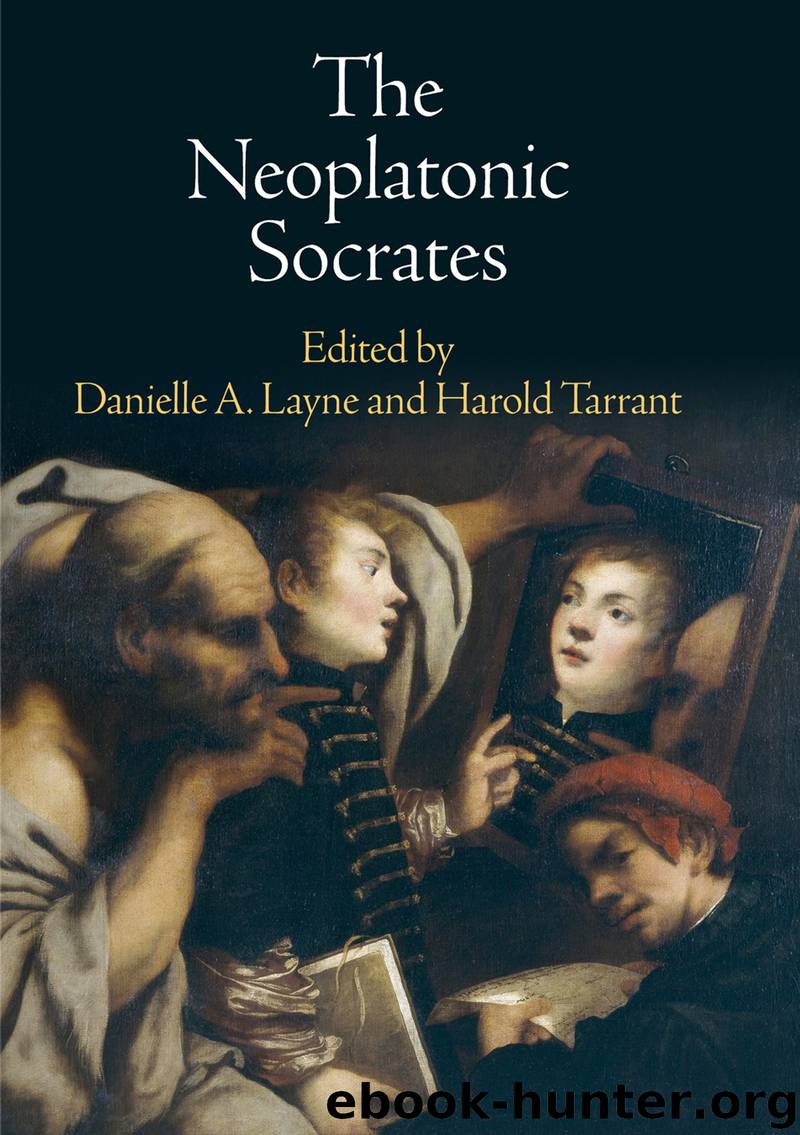
Author:Layne, Danielle A.; Tarrant, Harold;
Language: eng
Format: epub
Publisher: University of Pennsylvania Press
Published: 2019-04-15T00:00:00+00:00
Aristotle on Akrasia
As mentioned above, Aristotle thought that Socrates’ denial of akrasia contradicts the phenomenon. Unlike Socrates, Aristotle accepts that someone can be knowingly led by pleasure to do the worse thing. But, as for Socrates (and for Plato), for Aristotle some actions are done out of ignorance of the good. Having already made distinctions among types of ignorance in EN III, in EN VII10 he takes up the phenomenon unexplained by Plato’s Socrates by making distinctions of types of knowledge, vices, and weaknesses of will. He also addresses moral responsibility, which is virtually omitted in the Socratic account of akrasia. Threatened by the notion that akrasia can happen on the basis of belief or opinion rather than knowledge, Aristotle makes the argument (also made in the Eudemian Ethics)11 that akrasia involves knowledge rather than mere opinion. A definition of akrasia cannot be based on pure ignorance (never having learned)—that would count as a different cause for wrongdoing. Rather, one can knowingly do wrong by employing a distinction between two types of knowledge—general knowledge, and exercise of that knowledge in a given opportunity.12 Gerson described it aptly as “a disconnect between belief in the universal proposition and belief that it applies to oneself or to oneself now.”13
Akrasia involves a responsibility for one’s actions, even if impairment prevents one from remembering the general knowledge that was previously acquired, for the conditions that result in impairment were formed out of habits that might have been otherwise if knowledge had been exercised earlier in character formation. Actions arising from anger or appetite (thumos and epithumia, EN 1111b2) are not, according to Aristotle, involuntary,14 and akrasia arising out of these is similar to the forgetting of knowledge in sleep, madness, or drunkenness.15 Even in these states, Aristotle claims, possession of knowledge can be mimicked like actors reciting lines. Rather than being a temporary state like drunkenness, akrasia appears to have a more permanent nature. It is notable that throughout this discussion Aristotle refers to types of persons with a certain character or moral disposition, rather than to specific instances of self-control or lack of self-control within a given individual.
Continuing on this account, akrasia (notably translated as “Imperfect Self-Control” by D. P. Chase in the mid-nineteenth century)16 is the middle ground between those who are utterly depraved (either the criminally insane or those who practice evils as a custom)17 and a person of perfect self-mastery (ὁ σώφρων) who lacks strong or bad passions that need to be controlled. The akratic character is further distinguished from those who believe they are correct to pursue a pleasure (although it is an incorrect course of action) and those who are entirely lacking in self-control (ὁ ἀκόλαστος, 1146b20). The akolastic person is worse than the akratic and incurable.18 Aristotle also notes a difference between two main types of akrasia: the deliberative sort, and the impulsive nondeliberative or “precipitancy” akrasia.19 This difference is primarily one of temperament: the former is slower and allows deliberation but does not act on it
Download
This site does not store any files on its server. We only index and link to content provided by other sites. Please contact the content providers to delete copyright contents if any and email us, we'll remove relevant links or contents immediately.
| Anthropology | Archaeology |
| Philosophy | Politics & Government |
| Social Sciences | Sociology |
| Women's Studies |
Letters from a Stoic (Classics) by Seneca(1052)
The Last Days of Socrates by Plato & Christopher Rowe & Plato(1018)
Selected Political Speeches by Marcus Tullius Cicero(992)
De Anima (On the Soul) by Aristotle(902)
Latin Literature by Michael Grant(899)
The Constitution of Athens by Aristotle(862)
Delphi Complete Works of Cicero by Cicero(828)
The Greek World(824)
Letters from a Stoic by Seneca(823)
Marcus Aurelius by John Sellars(803)
Ancient Egypt: The Light of the World (Volume 2) by Massey Gerald (1828-1907)(775)
The Homeric Hymns (Penguin Classics) by Homer(756)
The Eudemian Ethics (Oxford World's Classics) by Kenny Anthony(742)
Latin Literature: An Anthology by Michael Grant(675)
The Nature of Things (Penguin Classics) by Lucretius(670)
Latin Literature (Penguin Classics) by Grant Michael(661)
Dialogues and Letters (Penguin Classics) by Seneca(613)
Meditations: Penguin Classics by Marcus Aurelius(597)
The Laws by Plato(587)
