The Collected Dialogues of Plato by Plato.;Cairns Huntington;Hamilton Edith;
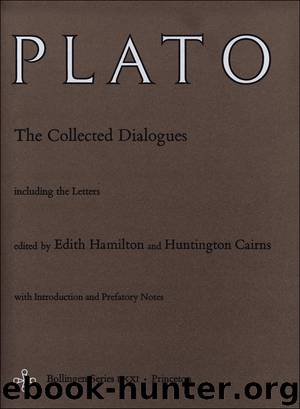
Author:Plato.;Cairns, Huntington;Hamilton, Edith; [Hamilton, Edith]
Language: eng
Format: epub
Publisher: Princeton University Press
Published: 1961-03-11T16:00:00+00:00
SOPHIST
The Parmenides, Philebus, Sophist, and Statesman are a group of dialogues which resemble each other and are different from all the rest. They are the last writing Plato did, with the exception of the Laws, which stands in a class by itself. In the Philebus, as has been pointed out, Plato announces that he is entering upon a new path, he is “forging weapons of another make,” changing his method of arguing. The dialogues cease to be conversations. They are close arguments rarely relieved by illustration, and only in the Philebus is the chief part given to Socrates. In the Sophist and the Statesman he is present, but takes no share in the discussion. He is not mentioned in the Laws.
In the Statesman, which follows the Sophist, there is a striking passage about “an impression of tediousness experienced in the discussion regarding the Sophist and the being of not-being.” Plato follows this up with—to paraphrase somewhat—“I know that it was felt to be too long and I reproached myself with this, fearing it was not only tedious, but irrelevant.” Here we are introduced to Plato’s audience, clearly a critical one. It charged Plato with being dull, the most intolerable of all accusations because the only one nobody can defend himself against. Plato was stung too sharply by it to bear this fact in mind. His attempt at defense is made with calm superiority. “We shall not look for such length in an argument as is ‘suitable’ for giving pleasure. If either a full-length statement of an argument or an unusually brief one leaves the hearer more able to find real forms, there must be no expression of annoyance at its length or its brevity as the case may be. A man who criticizes the length of an argument must be required to support his grumble with a proof that a briefer statement would have left him more able to demonstrate real truth by reasoned argument. Blame and praise on other grounds we must simply ignore and act as though we had not heard them at all.” For a moment Plato stands on the ordinary human level.
A very little reading in the Sophist shows how justified the critics were. It abounds in such statements as, “What is different is always so called with reference to another thing. It would not be so, if existence and difference were not very different things. If difference partook of both characters as existence does, there would sometimes be, within the class of different things, something that was different not with reference to another thing.” Or, “Motion really is a thing that is not and a thing that is. It must, then, be possible for ‘that which is not’ to be, not only in the case of motion but of all the other kinds. For in the case of them all the nature of difference makes each one of them different from existence, [e] and hence we shall be right to speak of them all as things that ‘are not,’ and again, because they partake of existence, to say that they ‘are.
Download
This site does not store any files on its server. We only index and link to content provided by other sites. Please contact the content providers to delete copyright contents if any and email us, we'll remove relevant links or contents immediately.
| Anthropology | Archaeology |
| Philosophy | Politics & Government |
| Social Sciences | Sociology |
| Women's Studies |
Letters from a Stoic (Classics) by Seneca(1055)
The Last Days of Socrates by Plato & Christopher Rowe & Plato(1019)
Selected Political Speeches by Marcus Tullius Cicero(994)
De Anima (On the Soul) by Aristotle(908)
Latin Literature by Michael Grant(900)
The Constitution of Athens by Aristotle(864)
Delphi Complete Works of Cicero by Cicero(833)
The Greek World(826)
Letters from a Stoic by Seneca(825)
Marcus Aurelius by John Sellars(804)
Ancient Egypt: The Light of the World (Volume 2) by Massey Gerald (1828-1907)(778)
The Homeric Hymns (Penguin Classics) by Homer(759)
The Eudemian Ethics (Oxford World's Classics) by Kenny Anthony(745)
Latin Literature: An Anthology by Michael Grant(678)
The Nature of Things (Penguin Classics) by Lucretius(672)
Latin Literature (Penguin Classics) by Grant Michael(662)
Dialogues and Letters (Penguin Classics) by Seneca(617)
Meditations: Penguin Classics by Marcus Aurelius(598)
The Laws by Plato(587)
