That One Should Disdain Hardships by Musonius Rufus
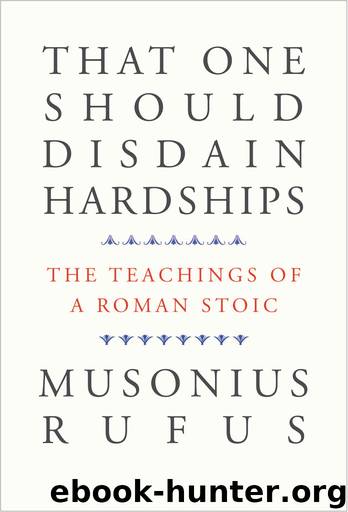
Author:Musonius Rufus [Rufus, Musonius]
Language: eng
Format: epub
Publisher: Yale University Press
Published: 2019-02-20T16:00:00+00:00
10
Will the Philosopher Prosecute Anyone for Personal Injury?
He said that he himself would never prosecute anyone for personal injury nor recommend it to anyone else who claimed to be a philosopher. For actually none of the things which people fancy they suffer as personal injuries are an injury or a disgrace to those who experience them, such as being reviled or struck or spit upon. Of these the hardest to bear are blows. That there is nothing shameful or insulting about them however is clear from the fact that Lacedaemonian boys are whipped publicly, and they exult in it. If, then, the philosopher cannot despise blows and insults when he ought obviously to despise even death, what good would he be? Well and good, you say, but the spirit of the man who does such things is monstrous, executing his purpose to insult by jeering and a slap in the face, or by abusive language, or by some other such action. You know, of course, that Demosthenes holds that people can insult even by a glance and that such things are intolerable and that men in one way or another are driven mad by them. So it is that men who do not know what is really good and what is shameful, having regard only for common opinion, think they are insulted if someone gives them a malignant glance or laughs or strikes them or reviles them. But the wise and sensible man, such as the philosopher ought to be, is not disturbed by any of these things. He does not think that disgrace lies in enduring them, but rather in doing them. For what does the man who submits to insult do that is wrong? It is the doer of wrong who forthwith puts himself to shame, while the sufferer, who does nothing but submit, has no reason whatever to feel shame or disgrace. Therefore the sensible man would not go to law nor bring indictments, since he would not even consider that he had been insulted. Besides, to be annoyed or racked about such things would be petty. Rather he will easily and silently bear what has happened, since this befits one whose purpose is to be noble-minded. Socrates, you remember, was clearly of this frame of mind who, though publicly ridiculed by Aristophanes, was not angry, but when he happened to meet him, asked him if he would like to use him for some other role. Can’t you imagine how quickly he would have flared up in anger at some petty abuse, this man who showed no concern even when abused in the public theater! And the good Phocion, when his wife had been reviled by someone, so far from prosecuting the fellow when he came in fear and asked forgiveness of Phocion, saying that he did not know it was his wife whom he had offended, merely replied, “But my wife has suffered nothing at your hands, though perhaps some other woman has, so you have no need to apologize to me.
Download
This site does not store any files on its server. We only index and link to content provided by other sites. Please contact the content providers to delete copyright contents if any and email us, we'll remove relevant links or contents immediately.
| Anthropology | Archaeology |
| Philosophy | Politics & Government |
| Social Sciences | Sociology |
| Women's Studies |
Letters from a Stoic (Classics) by Seneca(1052)
The Last Days of Socrates by Plato & Christopher Rowe & Plato(1018)
Selected Political Speeches by Marcus Tullius Cicero(992)
De Anima (On the Soul) by Aristotle(902)
Latin Literature by Michael Grant(899)
The Constitution of Athens by Aristotle(862)
Delphi Complete Works of Cicero by Cicero(828)
The Greek World(824)
Letters from a Stoic by Seneca(823)
Marcus Aurelius by John Sellars(803)
Ancient Egypt: The Light of the World (Volume 2) by Massey Gerald (1828-1907)(775)
The Homeric Hymns (Penguin Classics) by Homer(756)
The Eudemian Ethics (Oxford World's Classics) by Kenny Anthony(742)
Latin Literature: An Anthology by Michael Grant(675)
The Nature of Things (Penguin Classics) by Lucretius(670)
Latin Literature (Penguin Classics) by Grant Michael(661)
Dialogues and Letters (Penguin Classics) by Seneca(613)
Meditations: Penguin Classics by Marcus Aurelius(597)
The Laws by Plato(587)
