Learned, Experienced, and Discerning by O'Keefe Mark;
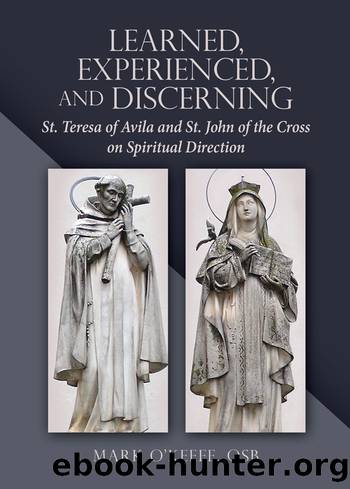
Author:O'Keefe, Mark;
Language: eng
Format: epub
Publisher: Liturgical Press
Published: 2020-07-23T06:13:50+00:00
1. Marcel Lépée, âSpiritual Direction in the Letters of St. Teresa,â in Carmelite Studies I: Spiritual Direction, ed. John Sullivan (Washington, DC: ICS Publications, 1980), 61â80.
Chapter Six
Direction for a Holistic Spirituality
Teresa of Jesus is rightly renowned as a teacher of prayer, and her major works provide classic descriptions and explanations of the deepest prayer experiences. Perhaps it would be easy to assume that her understanding of spiritual direction would therefore be focused exclusively on the topic of prayer. But Teresaâs spirituality was not disembodied, cut off from the ordinary events and interactions of daily life. She wrote about the path of contemplative and mystical prayer, because there were so few resources available to her nuns and to their close lay associates. But her books and letters reveal a woman with her feet firmly planted on the ground and a spirituality very much rooted in the ordinary. This is not the place to attempt a full examination of her embodied, holistic spirituality, but we must understand that, for Teresa, the Christian life is more than prayerâas must be the spiritual guidance that supports it.
In an earlier chapter, we noted the contemporary dissatisfaction with the term âspiritual direction.â âDirectionâ can seem to suggest that those seeking guidance or accompaniment surrender their own freedom to the authority or the presumed wisdom of the guide. The word âspiritual,â for its part, can seem to suggest that the subject matter of the relationship and conversation is narrowly or exclusively about prayer and transcendent relationship with God, cut off from ordinary life and relationships. But the guidance offered by Teresa, the great mystic and teacher of prayer, is by no means âspiritual,â in this narrow sense. All of her works reveal her active involvement in and concern for relationships, ordinary daily activities, and the broader common life of her nuns. In fact, she famously advised her nuns that âthe Lord walks among the pots and pansâ (F 5.8). God, then, could be found, not only in periods of quiet prayer, but also there in the kitchen where the nuns served each other in ordinary ways.
When she wrote the Way of Perfectionâintended as a kind of primer on prayerâTeresa intentionally devoted the first half of the work to speaking of essential virtues that must ground a life of prayer. These virtues, as she describes themâhumility, detachment, and love of othersâare practical and remain essential at every stage of the Christian journey. They are different aspects of the holistic transformation that feeds and is fed by deepening prayer. In a similar way, in the Interior Castle, Teresa describes an inner journey of prayer, self-awareness, and deep relationship with God. But although her focus there is the experience and description of prayer, she presupposes the broader transformation of life that must occur at every stage along the way. This perspective becomes clear in the critical image of the silkworm, which begins as an ugly worm but is transformed into a beautiful butterfly (IC 5.2â3). This is
Download
This site does not store any files on its server. We only index and link to content provided by other sites. Please contact the content providers to delete copyright contents if any and email us, we'll remove relevant links or contents immediately.
Machine Learning at Scale with H2O by Gregory Keys | David Whiting(4315)
Never by Ken Follett(3960)
Fairy Tale by Stephen King(3401)
Reminders of Him: A Novel by Colleen Hoover(3125)
The Man Who Died Twice by Richard Osman(3082)
Will by Will Smith(2928)
It Starts With Us (It Ends with Us #2) by Colleen Hoover(2370)
Rationality by Steven Pinker(2369)
Can't Hurt Me: Master Your Mind and Defy the Odds - Clean Edition by David Goggins(2344)
Friends, Lovers, and the Big Terrible Thing by Matthew Perry(2234)
The Becoming by Nora Roberts(2208)
The Stranger in the Lifeboat by Mitch Albom(2129)
Love on the Brain by Ali Hazelwood(2081)
New Morning Mercies: A Daily Gospel Devotional by Paul David Tripp(1920)
A Short History of War by Jeremy Black(1851)
HBR's 10 Must Reads 2022 by Harvard Business Review(1849)
The Strength In Our Scars by Bianca Sparacino(1847)
A Game of Thrones (The Illustrated Edition) by George R. R. Martin(1751)
Never Finished: Unshackle Your Mind and Win the War Within by David Goggins(1715)
