If God Knows What I Need, Why Should I Pray? by Kent Crockett
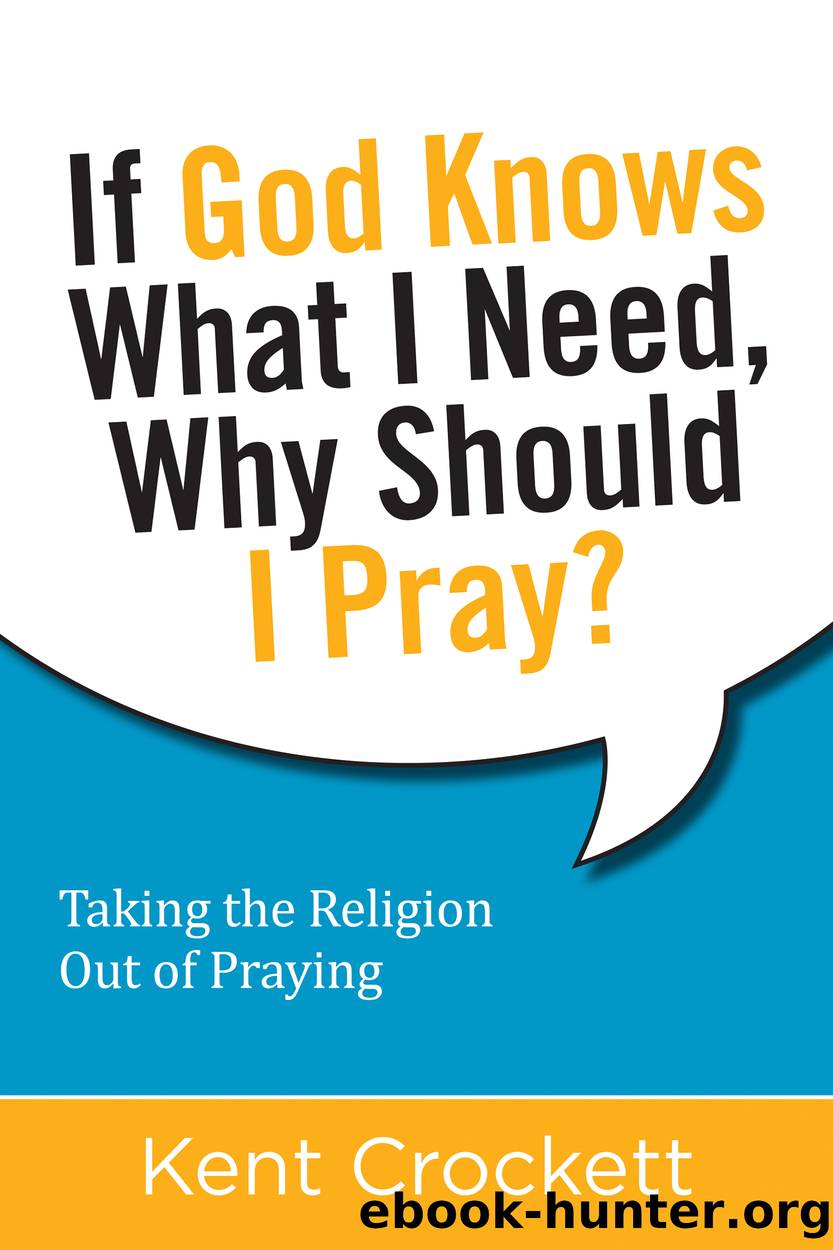
Author:Kent Crockett
Language: eng
Format: epub
Tags: how to pray;prayer life;praying;Christian living;prayer
ISBN: 9781619708884
Publisher: Hendrickson Publishers
Published: 2016-04-15T15:00:35+00:00
Does God Only Speak through the Bible?
Youâve probably heard of the Great Brinkâs Robbery. On January 17, 1950, a team of eleven thieves stole $2.7 million from the Brinkâs Armored Car depot in Boston. At the time, it was the largest robbery in the history of the United States. All eleven members of the gang were later arrested. But the real Great Brinkâs Robbery is when youâre on the brink of a blessing and someone interprets it away. Thereâs a sure way to make certain that this doesnât happen to you. The Holy Spirit, who inspired the Scriptures, will help you interpret passages correctly (see 2 Peter 1:20â21).
Some people believe God doesnât speak individually to people today because we have the entire Bible to read. They presuppose that the Lord only speaks through the Bible and that itâs the only way He communicates with His people. By making this incorrect assumption, they conclude that any revelation outside the Bible cannot be from God.
However, reading the Bible doesnât guarantee that He will speak to you through it or that you will hear His voice. Even though the Pharisees continually studied and memorized the Scriptures, Jesus told them, âYou have [not] heard His voice at any time. . . . You search the Scriptures because you think that in them you have eternal life. . . .â (John 5:37, 39). They never heard God speak to them through the Scriptures or in any other way, for that matter.
Adherents for this man-made doctrine, which teaches that God doesnât speak today, usually base their arguments on this Scripture: âFor we know in part and prophesy in part, but when the perfect comes, the partial will be done awayâ (1 Corinthians 13:9â10). This interpretation assumes that âthe perfectâ in this verse refers to the Bible, meaning that Christians didnât need any further information from God once the complete New Testament had been written. But while itâs certainly true that the Scriptures are Godâs recorded revelation to us, that doesnât mean He is limited to speaking only through them. If you have been taught this theology, would you please carefully consider these six problems with that interpretation of 1 Corinthians 13:9â10?
Problem 1. Nowhere in the Scriptures does it prophesy that a Bible will be written. An important principle in interpreting the Scriptures is to read the passage for what it actually says and not what you think it says. The phrase has been translated by Greek scholars as âwhen the perfect comesâ and not âwhen the Bible is written and completed.â Replacing the word âperfectâ with the word âBibleâ is altering the Scriptures for the sole purpose of substantiating a particular theology.
Problem 2. God does speak through the words in the Bible, but that does not exclude Him from also speaking information to our minds. This does not mean that additional Scriptures or other books can be added to the Bible. It simply means the Scriptures give general instructions to everyone, but the Holy Spirit can give specific guidance to each individual concerning what to do in their unique situations.
Download
This site does not store any files on its server. We only index and link to content provided by other sites. Please contact the content providers to delete copyright contents if any and email us, we'll remove relevant links or contents immediately.
Machine Learning at Scale with H2O by Gregory Keys | David Whiting(4292)
Never by Ken Follett(3935)
Fairy Tale by Stephen King(3369)
Reminders of Him: A Novel by Colleen Hoover(3088)
The Man Who Died Twice by Richard Osman(3070)
Will by Will Smith(2906)
Rationality by Steven Pinker(2350)
It Starts With Us (It Ends with Us #2) by Colleen Hoover(2338)
Can't Hurt Me: Master Your Mind and Defy the Odds - Clean Edition by David Goggins(2320)
Friends, Lovers, and the Big Terrible Thing by Matthew Perry(2219)
The Becoming by Nora Roberts(2188)
The Stranger in the Lifeboat by Mitch Albom(2113)
Love on the Brain by Ali Hazelwood(2059)
New Morning Mercies: A Daily Gospel Devotional by Paul David Tripp(1913)
A Short History of War by Jeremy Black(1842)
The Strength In Our Scars by Bianca Sparacino(1840)
HBR's 10 Must Reads 2022 by Harvard Business Review(1838)
A Game of Thrones (The Illustrated Edition) by George R. R. Martin(1711)
Never Finished: Unshackle Your Mind and Win the War Within by David Goggins(1703)
