A Companion to the Theology of John Webster by Allen Michael;Nelson R. David;Vanhoozer Kevin J.;
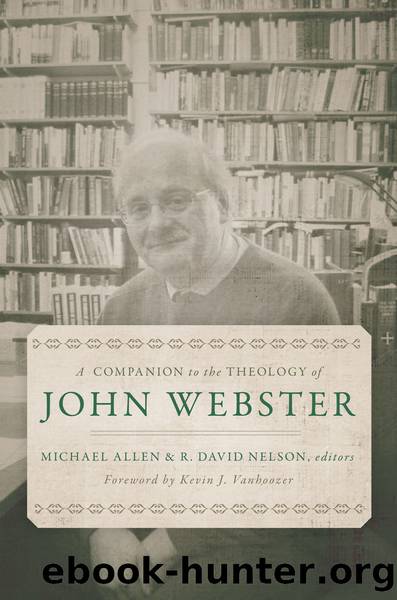
Author:Allen, Michael;Nelson, R. David;Vanhoozer, Kevin J.;
Language: eng
Format: epub
Publisher: Wm. B. Eerdmans Publishing Co.
Published: 2021-11-15T00:00:00+00:00
CHAPTER 10
The Perfection of God
Christopher R. J. Holmes
John Webster was a theologian of Godâs perfection. Godâs perfection, understood as âthe eternal depth of his creative goodness as the one who loves, elects, accompanies, reconciles, and glorifies creaturesâ is the center of Websterâs distinguished contribution to Christian theology. I can think of no other theologian of his generation (whether they be Protestant, Anglican, Roman Catholic, or Orthodox) who so pressed this point. In this chapter, I focus on what he said about Godâs perfection, why I think he said it, and how.
The theme of Godâs perfection became more and more a preoccupation of Websterâs. From the middle part of the first decade of the 2000s, we were treated to several essays and chapters that take up this theme. Perhaps the most arresting and clearest statement available is his 2011 essay, âPerfection and Participation.â Therein he reminds us of the âreference back,â or what he also calls the âbackward reference.â1 When considering Godâs works, we must always refer âback to the groundless, infinite life of God disclosed in them.â2 Perfection is thus âa positive, material concept.â3
In order to unfold its positive character, Webster takes up Thomas Aquinasâs idioms. Perfection equals âthis plenitude of processions.â4 The âanterior perfectionâ of God is his âpaternity, filiation, and spiration.â5 Perfection has a Trinitarian density. It denotes the relations of origin whereby God has his life. To use a Thomistic idiom, the perfection of God is convertible with the processions among the three. This is a crucial point. Clearly distancing himself from Karl Barth, Webster discourages us from conceiving of Godâs perfection âas a matter of Godâs free self-determination.â As Websterâs thinking matured, Barthâs work held less appeal to Webster, at least in this regard. Accordingly, Webster notes that Godâs perfection is not contrastive, âdiscontinuous with or antithetical to created reality.â6 It is, Webster argues, the positive truth that theology must ponder.
There is an economy of salvation precisely because God has life in and of himself. If such is the case, then we avoid confusing Godâs being with his outward activity. It is Aquinas on whom Webster draws in making this point. To be sure, Barth helps Webster to appreciate Godâs prevenience and sovereignty with respect to all that God does. However, Barth, as is well known, also describes Godâs outward activity in terms of Godâs being in act, something that Webster becomes less and less comfortable with. This is a subtle point, to be sure, but not an unimportant one. By pointing to Godâs will as the linchpin that holds together âthe realities of God in himself and Godâs economic presence,â we honor, Webster avers, Godâs plenitude and the immanent processions of the three as the basis for creation, reconciliation, and redemption.7
A few years earlier, in his Kantzer Lectures of 2007, Webster says that Godâs perfection is the âcondition of [his] presence.â8 Herein we see Websterâs blossoming approbation of Trinitarian metaphysics. Although his 2007 judgments are more guarded than those of only a few years later,
Download
This site does not store any files on its server. We only index and link to content provided by other sites. Please contact the content providers to delete copyright contents if any and email us, we'll remove relevant links or contents immediately.
Machine Learning at Scale with H2O by Gregory Keys | David Whiting(4296)
Never by Ken Follett(3937)
Fairy Tale by Stephen King(3372)
Reminders of Him: A Novel by Colleen Hoover(3097)
The Man Who Died Twice by Richard Osman(3073)
Will by Will Smith(2912)
Rationality by Steven Pinker(2352)
It Starts With Us (It Ends with Us #2) by Colleen Hoover(2350)
Can't Hurt Me: Master Your Mind and Defy the Odds - Clean Edition by David Goggins(2325)
Friends, Lovers, and the Big Terrible Thing by Matthew Perry(2220)
The Becoming by Nora Roberts(2189)
The Stranger in the Lifeboat by Mitch Albom(2115)
Love on the Brain by Ali Hazelwood(2062)
New Morning Mercies: A Daily Gospel Devotional by Paul David Tripp(1917)
A Short History of War by Jeremy Black(1843)
The Strength In Our Scars by Bianca Sparacino(1841)
HBR's 10 Must Reads 2022 by Harvard Business Review(1840)
A Game of Thrones (The Illustrated Edition) by George R. R. Martin(1728)
Never Finished: Unshackle Your Mind and Win the War Within by David Goggins(1706)
