You Did What?: Mad Plans and Great Historical Disasters by Edited by Bill Fawcett & Brian M. Thomsen
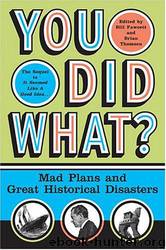
Author:Edited by Bill Fawcett & Brian M. Thomsen [Fawcett, Bill]
Language: zho
Format: epub
Tags: #genre
ISBN: 9780060532505
Publisher: New York : Perennial Currents, c2004.
Published: 2004-08-05T17:32:32+00:00
You Unleashed What?
“Never start something you can’t finish” is an old proverb. A pity that those who think their power is unlimited forget it so often. The Boxer Rebellion took place during the summer of 1900. By the time the conflict was over tens of thousands of people lay dead. The uprising led to the end of the Manchu dynasty and had such a negative impact on the Chinese psyche that it still colors that country’s attitude toward the rest of the world.
TZU HSI, EMPRESS DOWAGER OF CHINA
CHINA, 1900
William C. Dietz
Who screwed up? The answer is Tzu Hsi, the sixty-five-year-old Empress Dowager of China, also known to her subjects as the Old Buddha. When the Boxer Rebellion began, Tzu Hsi had ruled one way or another for nearly half a century. Things had not gone well for the Chinese, starting with their loss of the Opium War in 1840–1842 and continuing with a long list of humiliating concessions as the great powers robbed China of Hong Kong, Manchuria, Burma, what is now Vietnam, and ended their longtime domination of Korea. Germany, Russia, France, Britain, Japan and the United States all took turns carving profitable slices off the once-great empire.
That’s why Tzu Hsi hated the foreigners almost as much as the Boxers did and sought to use the Boxers as the means not only to cleanse China of foreign influence but to preserve the Manchu dynasty. It was a terrible mistake.
The Boxers were a little-known, poorly organized cult that was born of two earlier groups, the Big Swords, which was a group of landlords, farmers and peasants organized to protect themselves from bandits, and the Spirit Boxers, who drew their members from the poorest of the poor, and routinely practiced martial arts in public places. Hence the name Boxers. During their demonstrations members would call upon well-known spirits to enter their bodies and participate in scenes of mass possession. The displays, which incorporated traditional folktales, drew large enthusiastic crowds.
Much like the French underground in World War II, or the shadowy terrorist organizations of today, the movement referred to as the Boxers was actually an amalgamation of smaller groups having no central leadership. Religion, in the form of the traditional gods that practitioners allowed to possess them, plus the Chinese folk operas that they borrowed for use in their demonstrations, allowed the Boxers to tap into a common vocabulary of deities, superstitions and fears.
As a result, the Boxers were able to convince many members of the populace that their rites rendered them invulnerable to bullets and other weapons — claims that adherents sought to prove during wild demonstrations, when members of the audience were challenged to attack them. The wounds they sometimes suffered were dismissed as a failure to use the correct techniques and had little or no effect on recruiting.
The movement spread quickly and became especially popular in Shantung province, the place where Confucius was born. During the late 1800s not only was the area devastated by a series of natural
Download
This site does not store any files on its server. We only index and link to content provided by other sites. Please contact the content providers to delete copyright contents if any and email us, we'll remove relevant links or contents immediately.
Personalized inhaled bacteriophage therapy for treatment of multidrug-resistant Pseudomonas aeruginosa in cystic fibrosis by unknow(181722)
CONSORT 2025 statement: updated guideline for reporting randomized trials by unknow(90148)
Critical evaluation of the ProfiLER-02 study design and outcomes by Vivek Subbiah & Razelle Kurzrock(89753)
Cardiac gene therapy makes a comeback by Oliver J. Müller & Susanne Hille & Anca Kliesow Remes(89514)
Whisky: Malt Whiskies of Scotland (Collins Little Books) by dominic roskrow(74453)
Unveiling the design rules for tunable emission in graphene quantum dots: A high-throughput TDDFT and machine learning perspective by Şener Özönder & Mustafa Coşkun Özdemir & Caner Ünlü(50907)
A yeast-based oral therapeutic delivers immune checkpoint inhibitors to reduce intestinal tumor burden by unknow(40278)
Covalent hitchhikers guide proteins to the nucleus by Alexander F. Russell & Madeline F. Currie & Champak Chatterjee(40220)
Meet the Authors: Christopher R. Mansfield and Emily R. Derbyshire by Christopher R. Mansfield & Emily R. Derbyshire(40104)
Alkaline-earth metals promote propane dehydrogenation with carbon dioxide through geometric effects: Altering the reaction pathway by unknow(32746)
Induced iron vacancies boosting FeOOH loaded on sustainable Fenton-like collagen fiber membrane for efficient removal of emerging contaminants by unknow(32523)
Efficient electric-field-assisted photochemical conversion of methane to n-propanol exclusively over penetrated TiO2Ti hollow fibers by Guanghui Feng(32461)
Bi2SiO5 nanosheets as piezo-photocatalyst for efficient degradation of 2,4-Dichlorophenol by Hangyu Shi & Yifu Li & Lishan Zhang & Guoguan Liu & Qian Zhang & Xuan Ru & Shan Zhong(32401)
A novel NDIPTA organic heterojunction photocatalyst with built-in electric field for efficient hydrogen production by Jiahui Yang & Baojun Ma & Yongfa Zhu(32372)
Enhanced conversion of methane to liquid-phase oxygenates via hollow ferrite nanotube@horseradish peroxidase based photoenzymatic catalysis by Jun Duan & Shiying Fan & Xinyong Li & Shaomin Liu(32340)
Ordered macroporous superstructure of defective carbon adorned with tiny cobalt sulfide for selective electrocatalytic hydrogenation of cinnamaldehyde by Xiao-Shi Yuan & Sheng-Hua Zhou & San-Mei Wang & Wenbo Wei & Xiaofang Li & Xin-Tao Wu & Qi-Long Zhu(32263)
What's Done in Darkness by Kayla Perrin(27157)
Topological analysis of non-conjugated ethylene oxide cored dendrimers decorated with tetraphenylethylene: Insights from degree-based descriptors using the polynomial approach by A Theertha Nair & D Antony Xavier & Annmaria Baby & S Akhila(26545)
Investigation of mechanical and self-healing properties of hydroxyl-terminated polybutadiene functionalized with 2-ureido-4-pyrimidinone by Mohsen Kazazi & Mehran Hayaty & Ali Mousaviazar(26471)
