The 25-Year War: Americaâs Military Role in Vietnam by General Bruce Palmer Jr
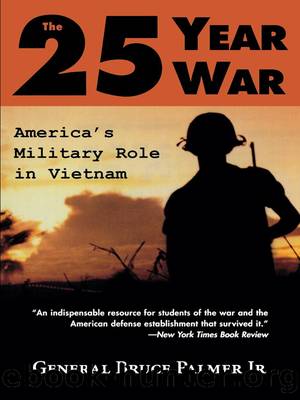
Author:General Bruce Palmer Jr.
Language: eng
Format: epub
Publisher: The University Press of Kentucky
Published: 2014-11-14T16:00:00+00:00
6
1972-1973: Cease-Fire Achieved
As the crucial year of 1972 approached, MACV and the Vietnamese Joint General Staff worked overtime to get the nationâs defenses in a better state of readiness to meet the next NVA invasion. It was expected to come in January or February 1972 and to hit hardest in the northern provinces of South Vietnam.
An important element of the Vietnamization program entailed a large expansion of the regular South Vietnamese forces, which increased by almost one-third (from about 825,000 to over a million), while Saigonâs paramilitary forces almost tripled in size (from 1.3 million to 4 million). (Most of the latter increase was in the Peopleâs Self-Defense Forces, which were armed with primitive weapons and had no organized units.)
The program for the regular forces (the Navy and Marine Corps doubled in size and the Air Force multiplied two and a half times) included a strenuous effort to build greater capabilities for air, naval, artillery, logistic, and other activities of a supporting nature. This effort involved training thousands of pilots, mechanics, navigators, engineers, and others requiring advanced skills, many of them in the United States, which in turn demanded a mastery of English as a prerequisite. Large numbers of U.S. aircraft, naval craft, armored vehicles, and artillery pieces were turned over to the South Vietnamese. Whether this program would give the South Vietnamese capabilities anywhere approaching U.S. standards was highly questionable. But given the limited time available to train the South Vietnamese in these long-term skills and to develop effective, modern forces, the program was probably the best that could have been achieved.
An encouraging development was the improvement in the combat performance of the 5th and 18th ARVN Divisions in III CTZ and the 7th ARVN Division in IV CTZ. On the negative side, ARVN divisions in II CTZ had not significantly improved, and this was a worrisome factor for the allied high command, who were well aware of the importance of the Central Highlands in Hanoiâs strategic thinking.1
The gravity of the situation in I and II CTZs was starkly heightened by the continuing withdrawal of U.S. combat troops. By mid-1971 almost two-thirds of American maneuver units had departed the theater, and by the end of 1971 there was less than a U.S. division equivalent total in the northern two corps tactical zones. Moreover, many of the so-called Free World forces had returned home. The South Korean government, however, agreed to retain its two-division force in II CTZ until the end of 1972, but operationally kept the force under wraps.
In addition to the withdrawal of American combat units, the senior American headquartersâMACV, USARV, 7th Air Force, and III Marine Amphibious Forceâhad been sharply reduced; the large U.S. headquarters in each CTZ that had controlled U.S. ground operations were replaced by small regional assistance groups; and most of the large, complex U.S. intelligence, communications, and logistics structures in Vietnam had been dismantled. Virtually all American-built bases had been turned over to the South Vietnamese, who lacked the means to secure and maintain them.
Download
This site does not store any files on its server. We only index and link to content provided by other sites. Please contact the content providers to delete copyright contents if any and email us, we'll remove relevant links or contents immediately.
Personalized inhaled bacteriophage therapy for treatment of multidrug-resistant Pseudomonas aeruginosa in cystic fibrosis by unknow(181721)
CONSORT 2025 statement: updated guideline for reporting randomized trials by unknow(90147)
Critical evaluation of the ProfiLER-02 study design and outcomes by Vivek Subbiah & Razelle Kurzrock(89750)
Cardiac gene therapy makes a comeback by Oliver J. Müller & Susanne Hille & Anca Kliesow Remes(89511)
Whisky: Malt Whiskies of Scotland (Collins Little Books) by dominic roskrow(74453)
Unveiling the design rules for tunable emission in graphene quantum dots: A high-throughput TDDFT and machine learning perspective by Şener Özönder & Mustafa Coşkun Özdemir & Caner Ünlü(50907)
A yeast-based oral therapeutic delivers immune checkpoint inhibitors to reduce intestinal tumor burden by unknow(40277)
Covalent hitchhikers guide proteins to the nucleus by Alexander F. Russell & Madeline F. Currie & Champak Chatterjee(40220)
Meet the Authors: Christopher R. Mansfield and Emily R. Derbyshire by Christopher R. Mansfield & Emily R. Derbyshire(40104)
Alkaline-earth metals promote propane dehydrogenation with carbon dioxide through geometric effects: Altering the reaction pathway by unknow(32743)
Induced iron vacancies boosting FeOOH loaded on sustainable Fenton-like collagen fiber membrane for efficient removal of emerging contaminants by unknow(32523)
Efficient electric-field-assisted photochemical conversion of methane to n-propanol exclusively over penetrated TiO2Ti hollow fibers by Guanghui Feng(32461)
Bi2SiO5 nanosheets as piezo-photocatalyst for efficient degradation of 2,4-Dichlorophenol by Hangyu Shi & Yifu Li & Lishan Zhang & Guoguan Liu & Qian Zhang & Xuan Ru & Shan Zhong(32400)
A novel NDIPTA organic heterojunction photocatalyst with built-in electric field for efficient hydrogen production by Jiahui Yang & Baojun Ma & Yongfa Zhu(32372)
Enhanced conversion of methane to liquid-phase oxygenates via hollow ferrite nanotube@horseradish peroxidase based photoenzymatic catalysis by Jun Duan & Shiying Fan & Xinyong Li & Shaomin Liu(32339)
Ordered macroporous superstructure of defective carbon adorned with tiny cobalt sulfide for selective electrocatalytic hydrogenation of cinnamaldehyde by Xiao-Shi Yuan & Sheng-Hua Zhou & San-Mei Wang & Wenbo Wei & Xiaofang Li & Xin-Tao Wu & Qi-Long Zhu(32263)
What's Done in Darkness by Kayla Perrin(27157)
Topological analysis of non-conjugated ethylene oxide cored dendrimers decorated with tetraphenylethylene: Insights from degree-based descriptors using the polynomial approach by A Theertha Nair & D Antony Xavier & Annmaria Baby & S Akhila(26545)
Investigation of mechanical and self-healing properties of hydroxyl-terminated polybutadiene functionalized with 2-ureido-4-pyrimidinone by Mohsen Kazazi & Mehran Hayaty & Ali Mousaviazar(26471)
