Jefferson, Madison, and the Making of the Constitution by Jeff Broadwater
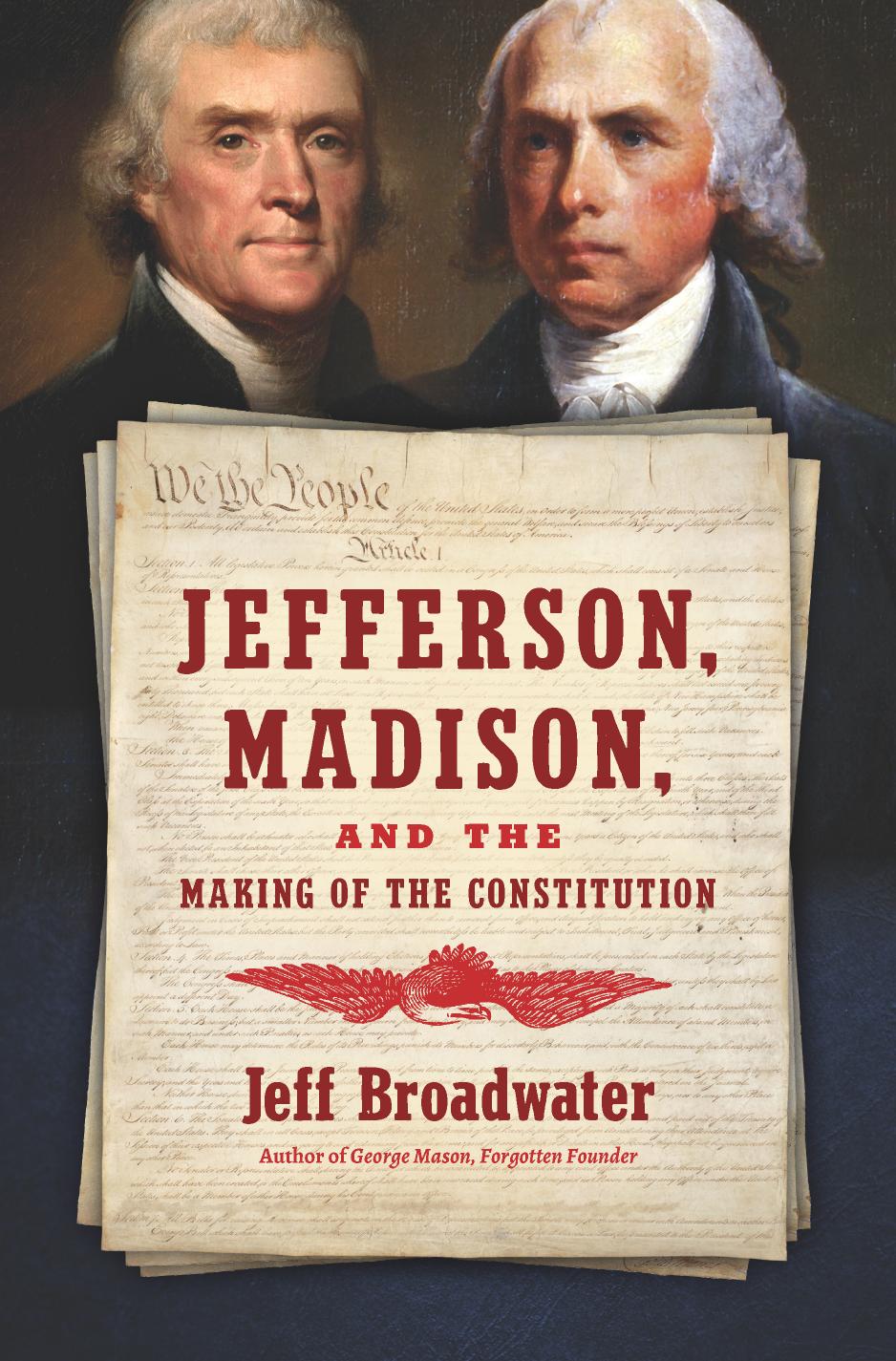
Author:Jeff Broadwater [Broadwater, Jeff]
Language: eng
Format: epub, pdf
Tags: History, United States, Revolutionary Period (1775-1800), Political Science, History & Theory, Constitutions
ISBN: 9781469651019
Google: M72luwEACAAJ
Publisher: University of North Carolina Press
Published: 2019-01-15T00:46:57+00:00
SEVEN
Opposition Enough to Do Good
1787â1788
THE VIRGINIA DELEGATE Edward Carrington had urged James Madison to hurry from Philadelphia to New York City, where Congress was sitting. The Constitution had split the Virginia delegation. Carrington and Henry Lee supported the document; Richard Henry Lee and William Grayson opposed it. Madisonâs vote would break the impasse. As Madison reported to George Washington in late September 1787, âI found on my arrival here that certain ideas unfavorable to the Act of the Convention which created difficulties in that body, had made their way into Congress.â1
He should not have been surprised by the opposition. Rhode Island had boycotted the Philadelphia convention. Two of the three New York delegates had walked out in protest. Fifty-five delegates had attended at one time or another, but only forty-two had stayed until the end, and of those, Elbridge Gerry of Massachusetts and two Virginians, George Mason and Edmund Randolph, refused to sign the Constitution. Masonâs âObjections to This Constitution of Governmentâ would appear in Philadelphia in early October. Mason, Madison later wrote Jefferson, âconsiders the want of a Bill of Rights as a fatal objection . . . and most probably of allâ opposed the proposed new government because of its âpower of regulating trade, by a majority only of each House.â Although Madison did not consider Randolph to be âinveterate in his opposition,â the Virginia governor harbored reservations about the breadth of federal power and the possibility of collusion between the president and the Senate, and he favored holding a second convention to address objections to the Constitution.2
The Philadelphia convention had hoped Congress would bless the Constitution and forward it to the states for their approval, but Richard Henry Lee and the Massachusetts delegate Nathan Dane argued that it conflicted with the Articles of Confederation, which strictly speaking it did, and that Congress could not, therefore, lawfully consider it. Madison and his allies overcame that obstacle. As Madison put it, not to approve the Constitution would imply that Congress considered the document flawed since âCongress had never scrupled to recommend measures foreign to their Constitutional functions, whenever the public good seemed to require it.â Richard Henry Lee next proposed amendments, including a bill of rights and a provision requiring proportional representation in the Senate. It must have irritated Madison to defend, in effect, state equality in the upper house, but had Congress made changes to the Constitution, it arguably would have triggered the amendment process of the Articles, requiring the unanimous consent of the state legislatures, and would have doomed the Constitution to defeat. By 28 September, however, the delegates had agreed on a unanimous resolution simply sending the Constitution to the state legislatures for referral to state conventions, which gave the impression that Congress supported the Constitution without actually saying so.3
Madison sent a copy of the Constitution to Jefferson around the first of November, weeks after he had mailed copies to other correspondents. âJefferson,â Dumas Malone has written, âmay have suspected he was not in Madisonâs full confidence.
Download
Jefferson, Madison, and the Making of the Constitution by Jeff Broadwater.pdf
This site does not store any files on its server. We only index and link to content provided by other sites. Please contact the content providers to delete copyright contents if any and email us, we'll remove relevant links or contents immediately.
The Vikings: Conquering England, France, and Ireland by Wernick Robert(84450)
Ali Pasha, Lion of Ioannina by Eugenia Russell & Eugenia Russell(40340)
The Conquerors (The Winning of America Series Book 3) by Eckert Allan W(38186)
The Vikings: Discoverers of a New World by Wernick Robert(37028)
Cecilia; Or, Memoirs of an Heiress — Volume 1 by Fanny Burney(32666)
Cecilia; Or, Memoirs of an Heiress — Volume 2 by Fanny Burney(32034)
Cecilia; Or, Memoirs of an Heiress — Volume 3 by Fanny Burney(32014)
Empire of the Sikhs by Patwant Singh(23162)
The Secret History by Donna Tartt(19377)
Hans Sturm: A Soldier's Odyssey on the Eastern Front by Gordon Williamson(18683)
Cat's cradle by Kurt Vonnegut(15481)
Pimp by Iceberg Slim(14724)
Sapiens: A Brief History of Humankind by Yuval Noah Harari(14493)
Norse Mythology by Gaiman Neil(13493)
Talking to Strangers by Malcolm Gladwell(13481)
Leonardo da Vinci by Walter Isaacson(13436)
4 3 2 1: A Novel by Paul Auster(12554)
Underground: A Human History of the Worlds Beneath Our Feet by Will Hunt(12184)
The Radium Girls by Kate Moore(12126)
